Embodiment
Alignment
Retarget whole-body human motion into the robot embodiment.
Paper accepted to CoRL 2026
DexRoam unlocks motion-level human data for mobile bimanual dexterous manipulation by transforming egocentric whole-body demonstrations into a continuous, coupled, robot-compatible action space. It provides a complete pipeline spanning tracker-free egocentric human motion capture, whole-body human-to-robot alignment, temporal action transformation, and VLA-based policy learning, enabling scalable and data-efficient robot learning from diverse human demonstrations while reducing the reliance on costly robot teleoperation data.
Across five real-world tasks and two VLA backbones, aligned human demonstrations raise average success from 29% to 56% on GR00T N1.7 and from 32% to 57% on π0.5, while matching robot-only training with 50% fewer robot demonstrations.
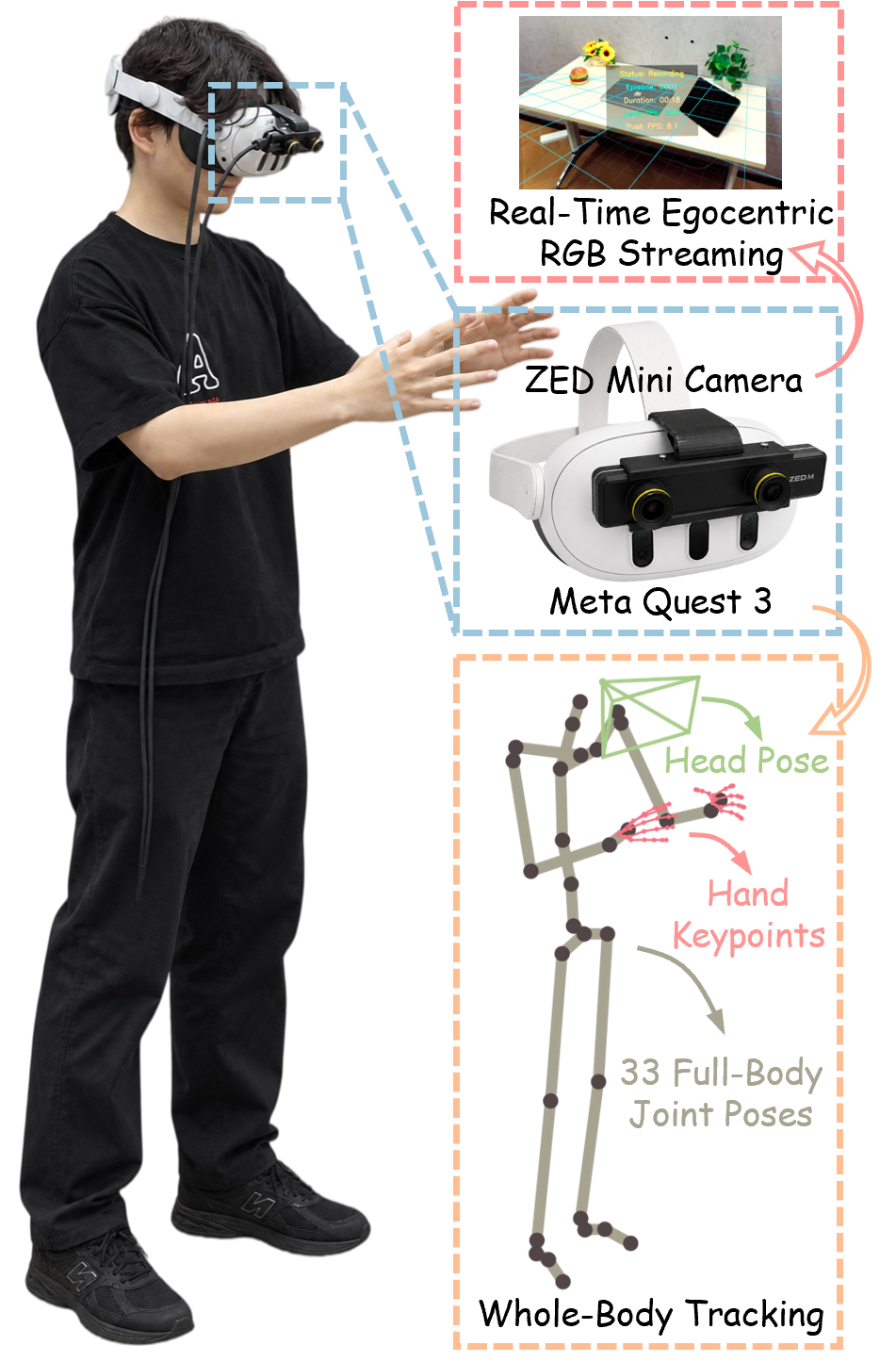
Portable capture
Portable egocentric capture of RGB and whole-body human motion, without external cameras or body-worn trackers.
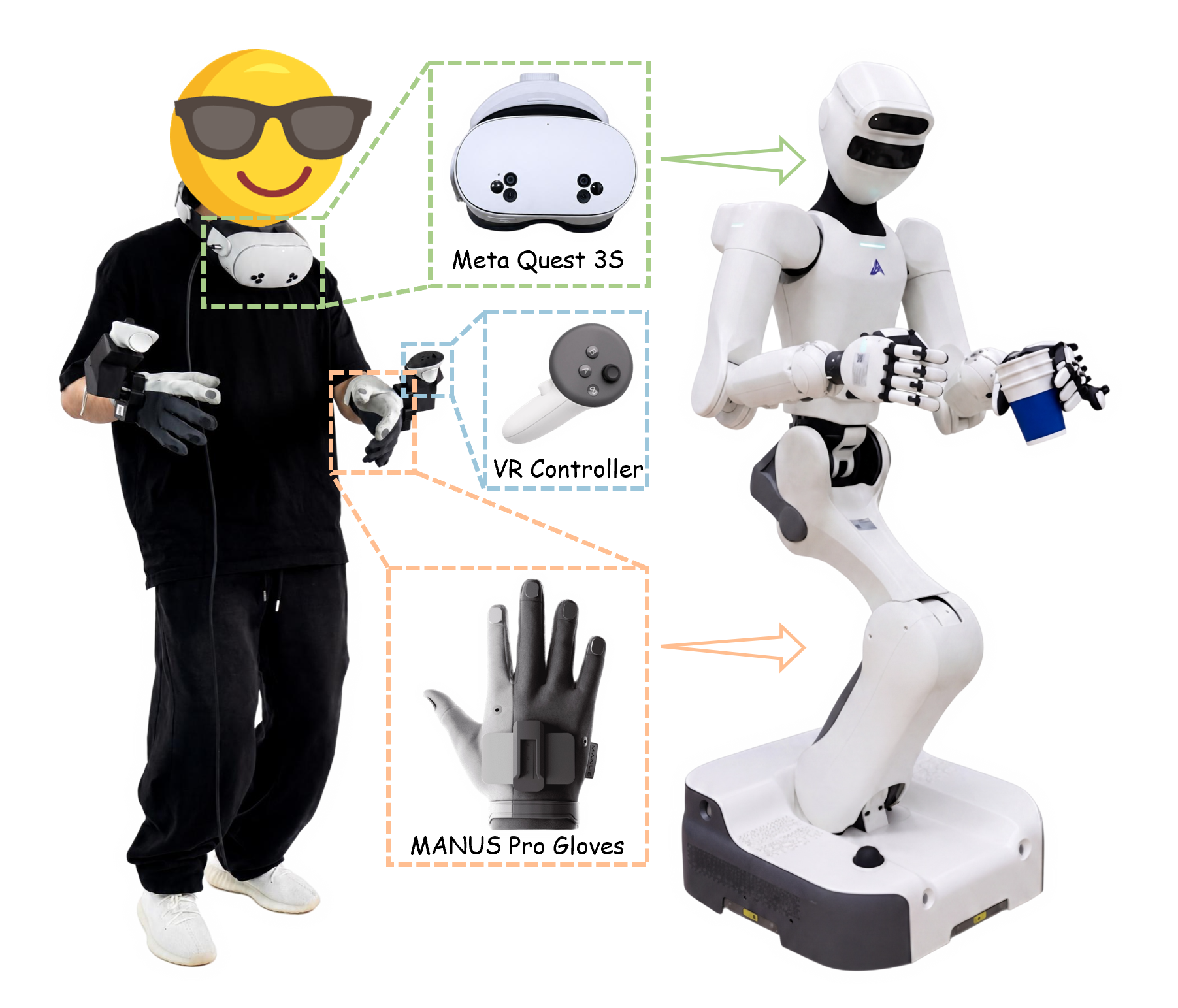
Robot teleoperation
A single operator simultaneously controls locomotion, torso, dual arms, head, and dexterous hands for synchronized whole-body demonstrations.
Human motion, robot-ready
Three explicit stages bridge different bodies, control semantics, and execution speeds — without losing the coordination of whole-body motion.
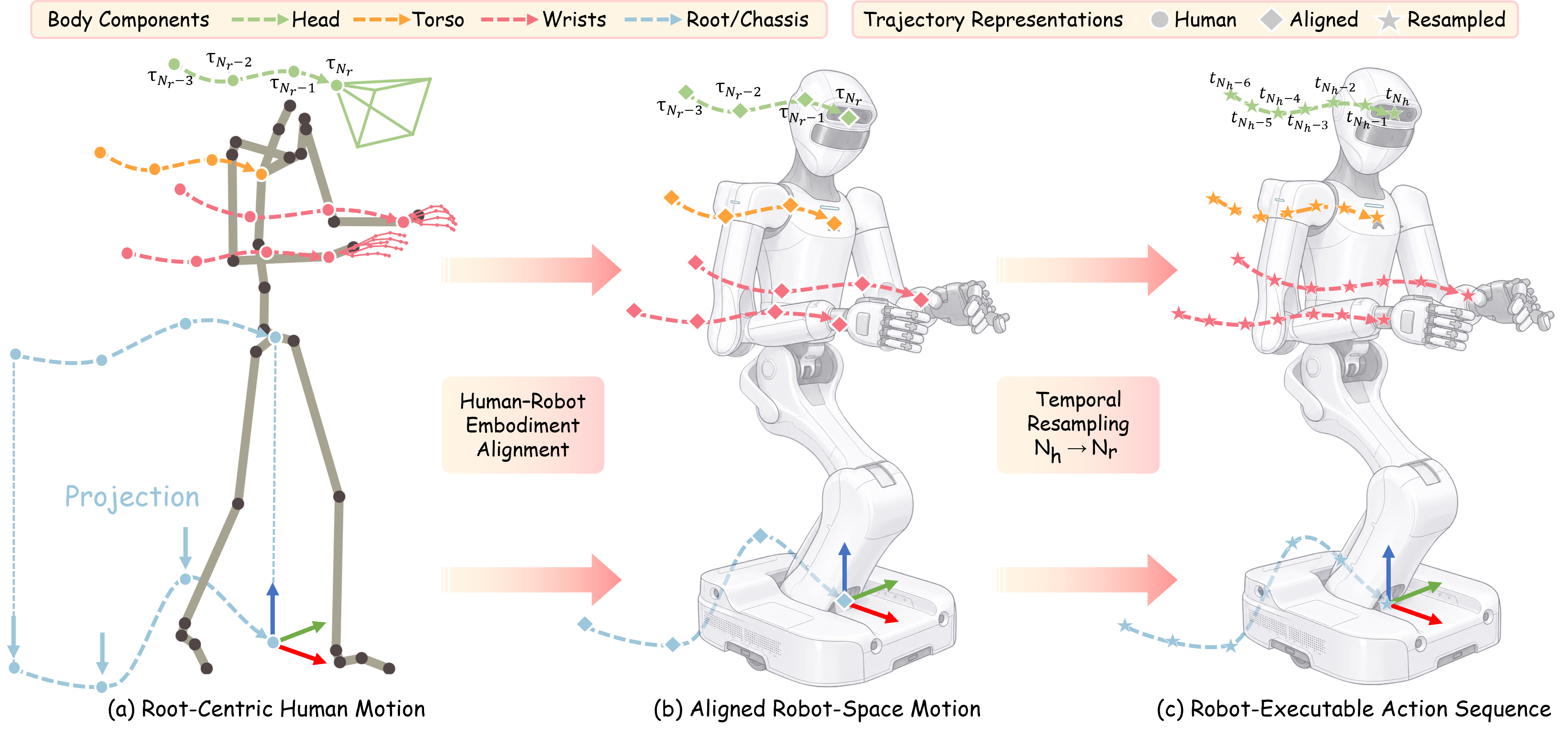
Retarget whole-body human motion into the robot embodiment.
Express motion as robot-centric relative actions with shared control semantics.
Resample trajectories by task progress to match robot execution timescales.
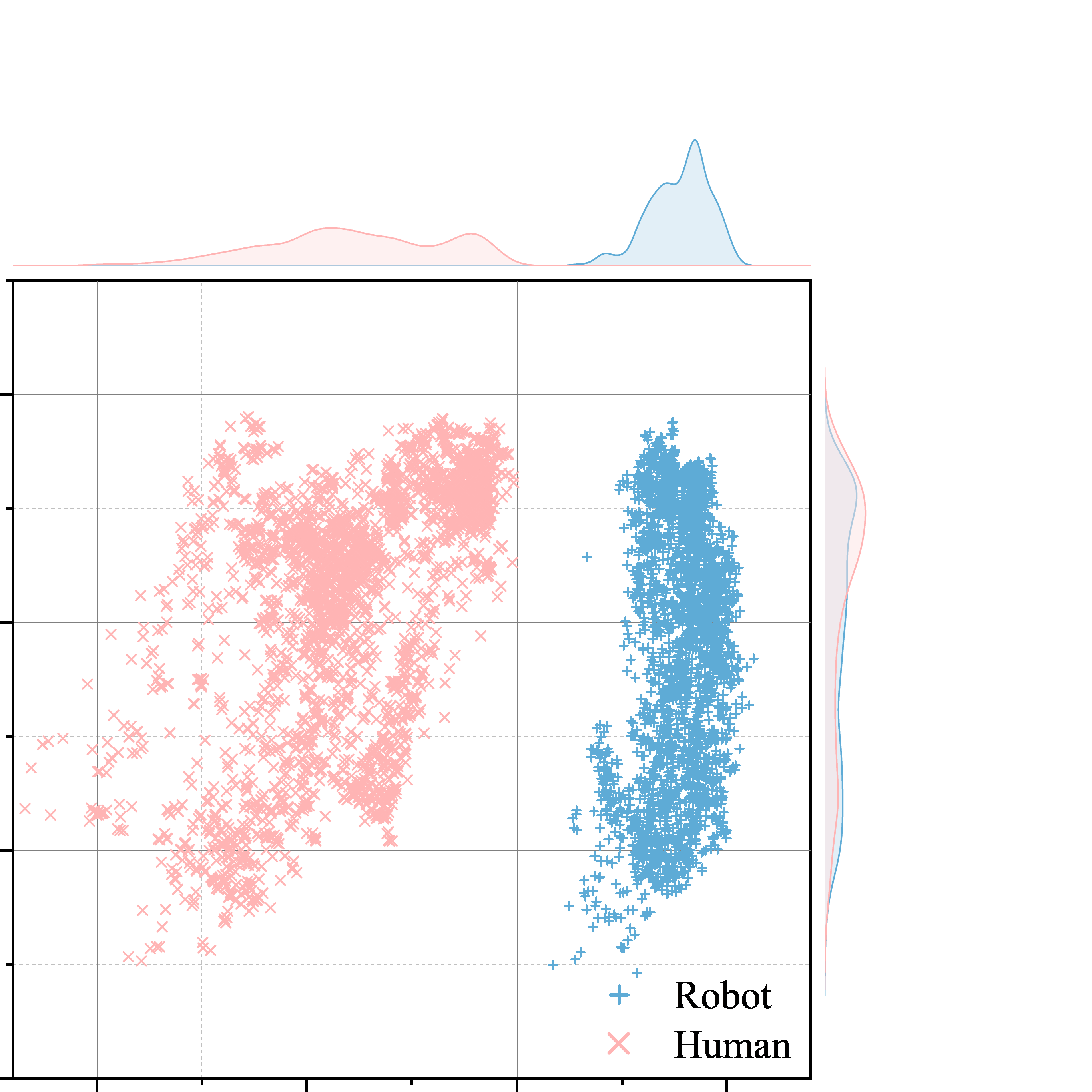
Alignment results
Human and robot whole-body action distributions before and after full alignment.
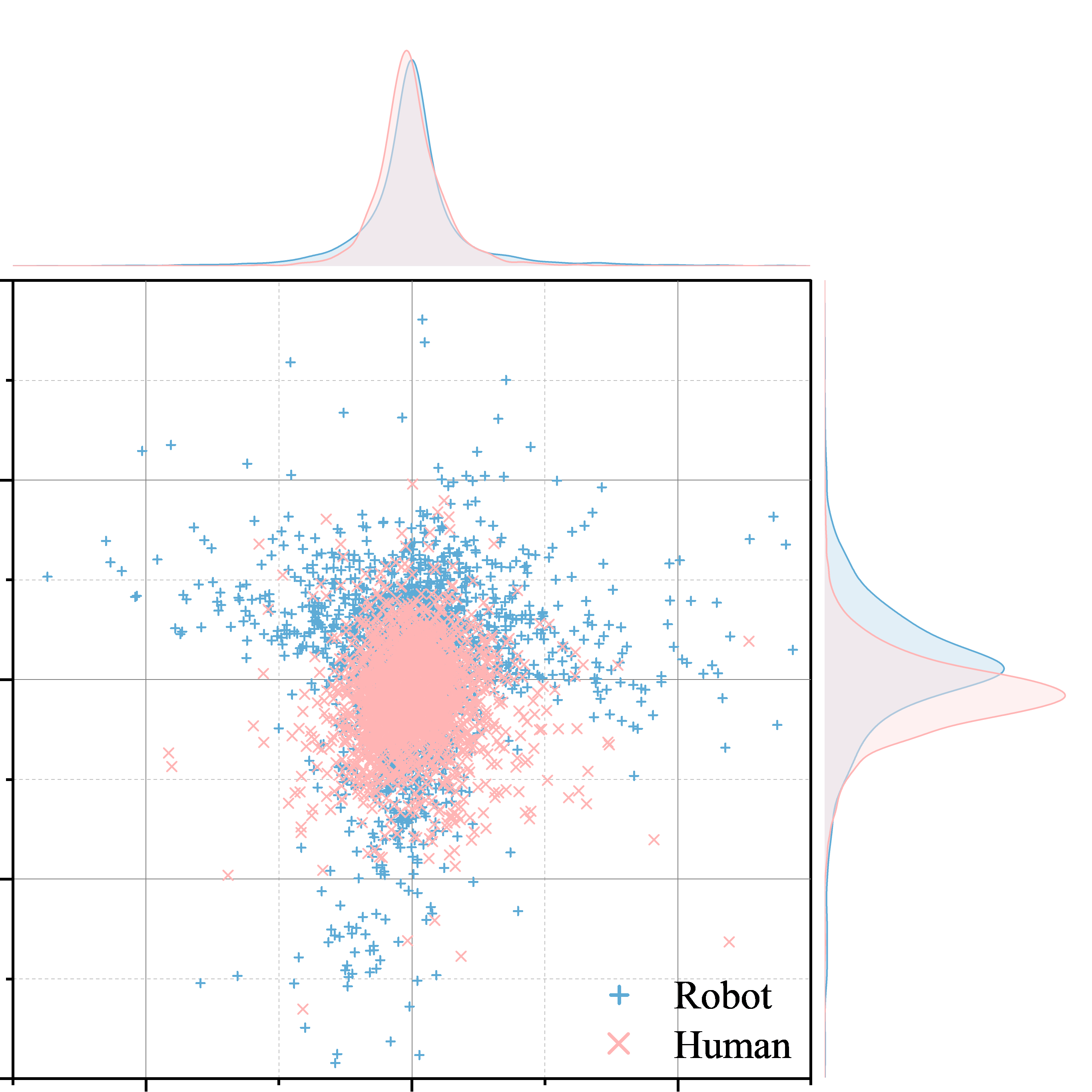
Real-world deployment
Real-robot evaluation across diverse mobile manipulation tasks.
03 · Policy learning
Does aligned human supervision improve policy learning, and which training paradigm leverages it most effectively?
04 · Data efficiency
How does aligned human data improve robot learning with limited robot demonstrations?
50% fewer robot demonstrations. With 25 robot demonstrations, human-assisted training approaches or matches the 50-demo Robot-only reference across the evaluated tasks.
@article{zhou2026dexroam,
  title={DexRoam: Learning Mobile Bimanual Dexterous Manipulation from Egocentric Whole-Body Human Demonstrations},
  author={Zhou, Rui and Yuan, Yibo and Zhao, Junkai and Zhao, Fangyuan and Zhao, Xiaoguang and Zhang, Shanghang and Han, Sirui},
  journal={arXiv preprint arXiv:2609.35761},
  year={2026}
}